Brussels Chocolate Workshop
Tours & tickets

Hand-picked by our editors — only the best 5 experiences from 38 reviewed.

Open today 10:00–18:00
Attendance: Moderate — summer peak
Last entry is at 17:00
Free cancellation Instant confirmation Mobile voucher Verified partner Book now, pay later
Tickets

Choose your ticket

Verified partners for every tour, free cancellation where available, and instant confirmation on every booking.

Belgian Chocolate Making Workshop 2 hr 30 min
Standard Entry

Belgian Chocolate Making Workshop

4.8 (997)
€59
per person
Instant Mobile voucher Flexible — change up to 24h

Craft over 30 artisan chocolates from scratch in a hands-on Brussels workshop led by expert chocolatiers.

Reserve
Bean-to-Bar Chocolate Workshop with Certified Chocolatiers 1 hr 30 min
Standard Entry

Bean-to-Bar Chocolate Workshop with Certified Chocolatiers

4.7 (1778)
€70
per person
Instant Mobile voucher Flexible — change up to 24h

Craft truffles, mendiants and your own chocolate bar in a working bean-to-bar factory led by government-certified artisans

Reserve

Prices from verified partners. Availability updates in real time at checkout. Free cancellation policies apply where shown.

Highlights

What you'll see inside the attraction

The landmarks, rooms, and views travelers on this tour remember — all visible on a single visit.

Mayan Temple Exhibition

Explore the historical origins of cocoa consumption from 5,000 years ago in this immersive setting.

Praline Demonstration Stage

Watch a master chocolatier craft traditional Belgian pralines live and enjoy fresh tastings.

Cocoa Collection Gallery

View over 600 unique historical objects detailing the evolution of chocolate production.

European Cocoa History Zone

Discover how cocoa beans were brought to Europe and transformed into a luxury treat.

Chocolate Workshop Area

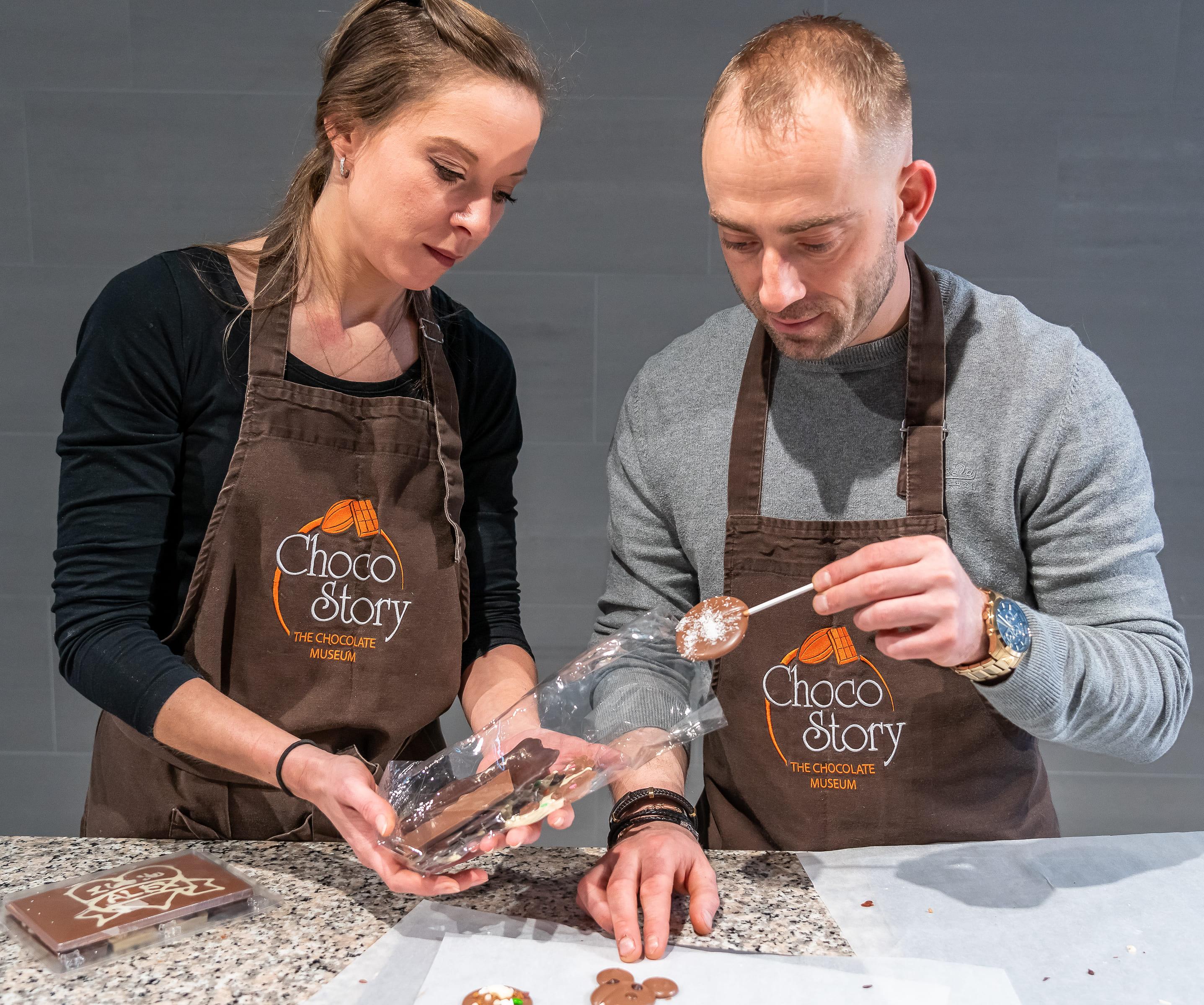
Create your own chocolate delights and lollipops under the guidance of professional chocolatiers.

Head to head

Choco-Story Brussels vs Belgian Chocolate Village for Your Brussels Chocolate Walking Tour and Workshop Experience

Choco-Story offers an accessible, city-center museum experience, while the Belgian Chocolate Village provides a deeper look into industrial history within a more residential neighborhood.

Feature Top pick Choco-Story Brussels Belgian Chocolate Village
Location
Koekelberg (Residential)
Museum Size
Spacious former industrial site
Primary Focus
Industrial production and botanical greenhouse
Accessibility
Metro or bus transit required
Workshop Variety
Extensive artisan craft demonstrations
Audience Type
Families and history enthusiasts

Verdict: Most visitors preferring convenience for a brussels chocolate walking tour and workshop tour select Choco-Story, while those seeking spacious industrial heritage gravitate toward the Belgian Chocolate Village.

How your ticket works

Book your ticket in 3 steps

  1. 01

    Book online

    Choose your ticket, select your date, and reserve in under two minutes. Secure checkout handled by our verified partner.

  2. 02

    Receive your mobile voucher

    Instant confirmation by email, with a mobile voucher you can save offline. No printing, no queuing at a collection desk.

  3. 03

    Show & enter

    Arrive at the entrance, show your voucher on your phone, and walk in. Most tickets include priority or skip-the-line access.

Plan your visit

Everything you need to know before you go

Practical details for your visit straight from our verified partners — hours, access, rules, and how to get there.

Open today · 10:00–18:00
Opening hours
10:00–18:00
Address
Rue de l'Etuve 41, 1000 Brussels, Belgium
Wheelchair access
Manual wheelchairs only; electric wheelchairs prohibited
Best arrival
10:00–12:00
Stroller policy
Strollers prohibited; use baby carrier
Meeting point
Choco-Story Brussels reception
Mon
10:00–18:00
Tue
10:00–18:00
Wed
10:00–18:00
Thu
10:00–18:00
Fri
10:00–18:00
Sat
10:00–18:00
Sun
10:00–18:00
Closed on: Jan 1 (New Year's Day), Dec 25 (Christmas Day)
Location

Address
Rue de l'Etuve 41, 1000 Brussels, Belgium
Stroller policy
Strollers prohibited; use baby carrier
Meeting point
Choco-Story Brussels reception

Dress code

Casual attire is recommended. Please wear comfortable shoes as the tour involves walking through three floors of the museum.

Bags & security

Lockers may be available for small items, but bulky bags and strollers are prohibited inside the exhibition area.

Photography

Photography is generally allowed for personal use in most exhibits, but please respect instructions from staff in the demonstration area.

Accessibility

The museum is accessible to visitors using manual wheelchairs, though it is not suitable for electric wheelchairs. Please contact the team for assistance if you have specific mobility requirements.

What to bring

  • Valid ID
  • Confirmation voucher
  • Comfortable shoes
  • Baby carrier
  • Water bottle

Not allowed

  • Electric wheelchairs
  • Strollers
  • Large luggage
  • Outside food
  • Alcohol
  • Sharp metallic tools
  • Pets
  • Professional photography lighting
  • Hazardous materials

Families & strollers

The brussels chocolate walking tour and workshop is highly family-friendly, though children under 12 must be accompanied by an adult. Strollers are not permitted in the exhibition areas.

Food & drink

Outside food and drinks are not allowed inside the museum. Your visit includes various artisanal chocolate tastings provided as part of the experience.

Around your visit

Everything else worth knowing

Best time to go, insider tips, nearby landmarks, and the cancellation fine print — flip through to skim what matters to you.

Cancellation policy

Flexible, no hidden fees.

Full refund available for cancellations made at least 24 hours in advance. Entrance fee is 16 EUR for adult museum admission including audio guide and chocolate tastings.

About

The place, in context

Cocoa reached Brussels as a monastic import: in 1635, the Abbey of Baudeloo in Ghent recorded chocolate among its provisions, decades before Belgium existed as a state. What began as a clerical curiosity became an industrial signature. Jean Neuhaus, a Swiss-born apothecary, opened a pharmacy on the Galeries Royales Saint-Hubert in 1857 and coated his medicines in chocolate. His grandson filled a hardened shell with soft ganache in 1912 and called it a praline. In 1915 the ballotin — the folded paper box — followed. Both remain Belgian standards. Choco-Story Brussels occupies a house at Rue de l'Etuve 41, a narrow street that runs from the Grand-Place to the Manneken Pis fountain a few doors down. The building is seventeenth-century in bones, its cellars vaulted in brick. The collection traces cacao from Olmec and Maya ritual vessels through Spanish court consumption to the mechanised conching of the nineteenth century. Antique moulds, tempering marble, and a working demonstration bench sit alongside the audio guide's twelve languages. Admission is 16 EUR, covering the guide and tastings drawn from the house's own production. The museum matters because Belgium's cocoa reputation was built on colonial extraction from the Congo Free State, and the exhibition does not omit this. Panels address plantation labour, contemporary cocoa pricing, and the Ivorian and Ghanaian farms that supply most European couverture today. A brussels chocolate walking tour and workshop that begins here therefore begins with a supply chain, not a sweet. The city around it supplies context no vitrine can. Within four hundred metres stand the guildhalls of the Grand-Place, gilded in 1697 after Marshal de Villeroy's bombardment levelled the square. Within a kilometre, a dozen chocolatiers still temper by hand. Bean-to-bar producers have multiplied since 2015, roasting single-origin beans in small drums rather than buying industrial couverture, and certified chocolatiers now teach the technique publicly. The Belgian chocolate making workshop, once a trade secret guarded by apprenticeship, has become an accessible craft lesson. Tempering is the discipline at the heart of it. Cocoa butter crystallises in six forms; only the fifth gives gloss and a clean snap. Chocolatiers reach it by heating to 45°C, cooling to 27°C on marble, then warming to 31°C. Every praline made in the workshops on this page depends on that curve. It explains why brussels chocolate walking tour and workshop tickets sell as craft instruction rather than tasting alone, and why a bar bought on Rue de l'Etuve behaves differently from a supermarket equivalent.

"Cocoa butter crystallises in six forms; only the fifth gives gloss and a clean snap."
Your experience

What a tour day looks like

A step-by-step walkthrough of the visit — what you'll see, how long each stage takes, and the details that matter.

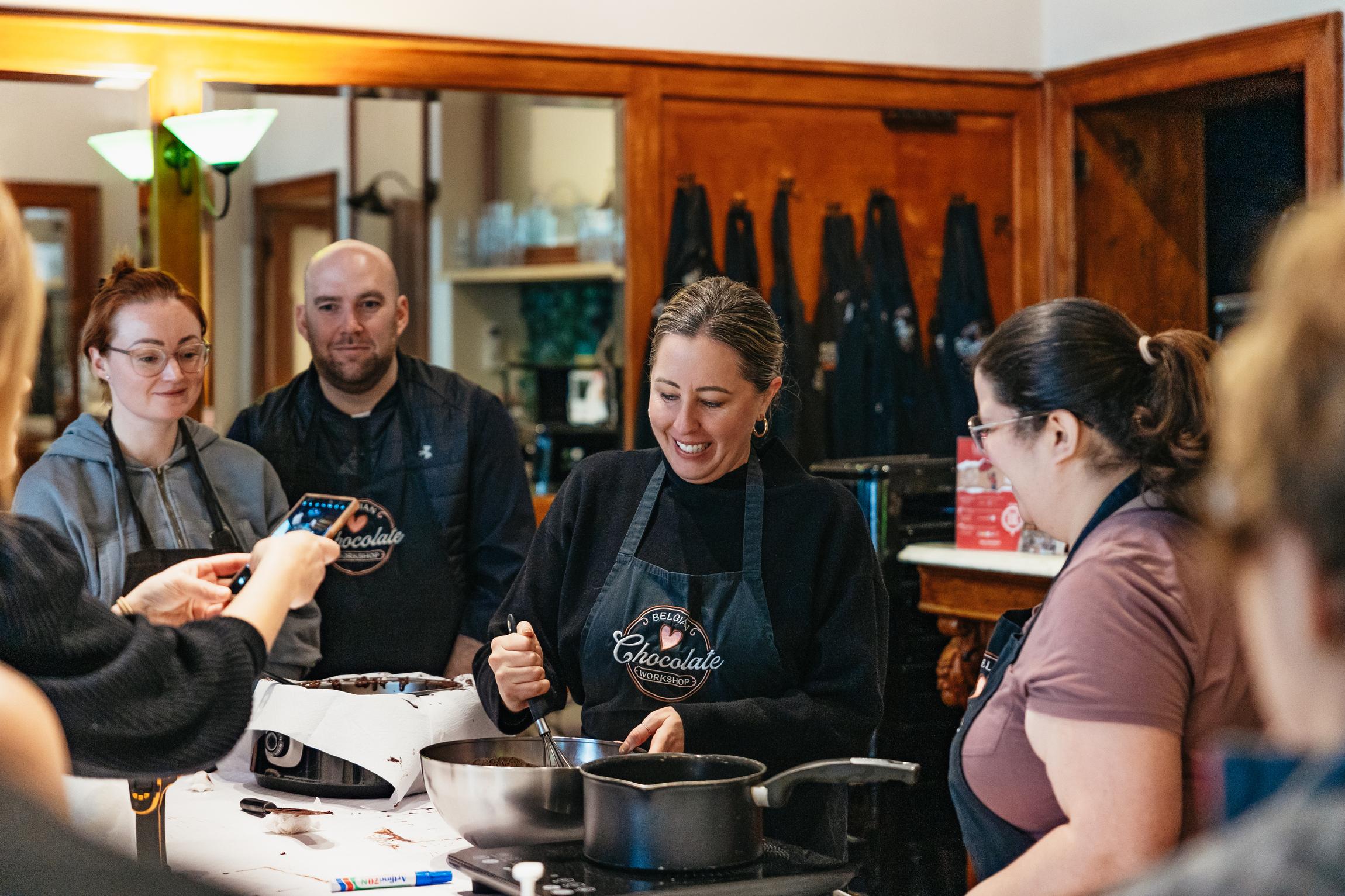
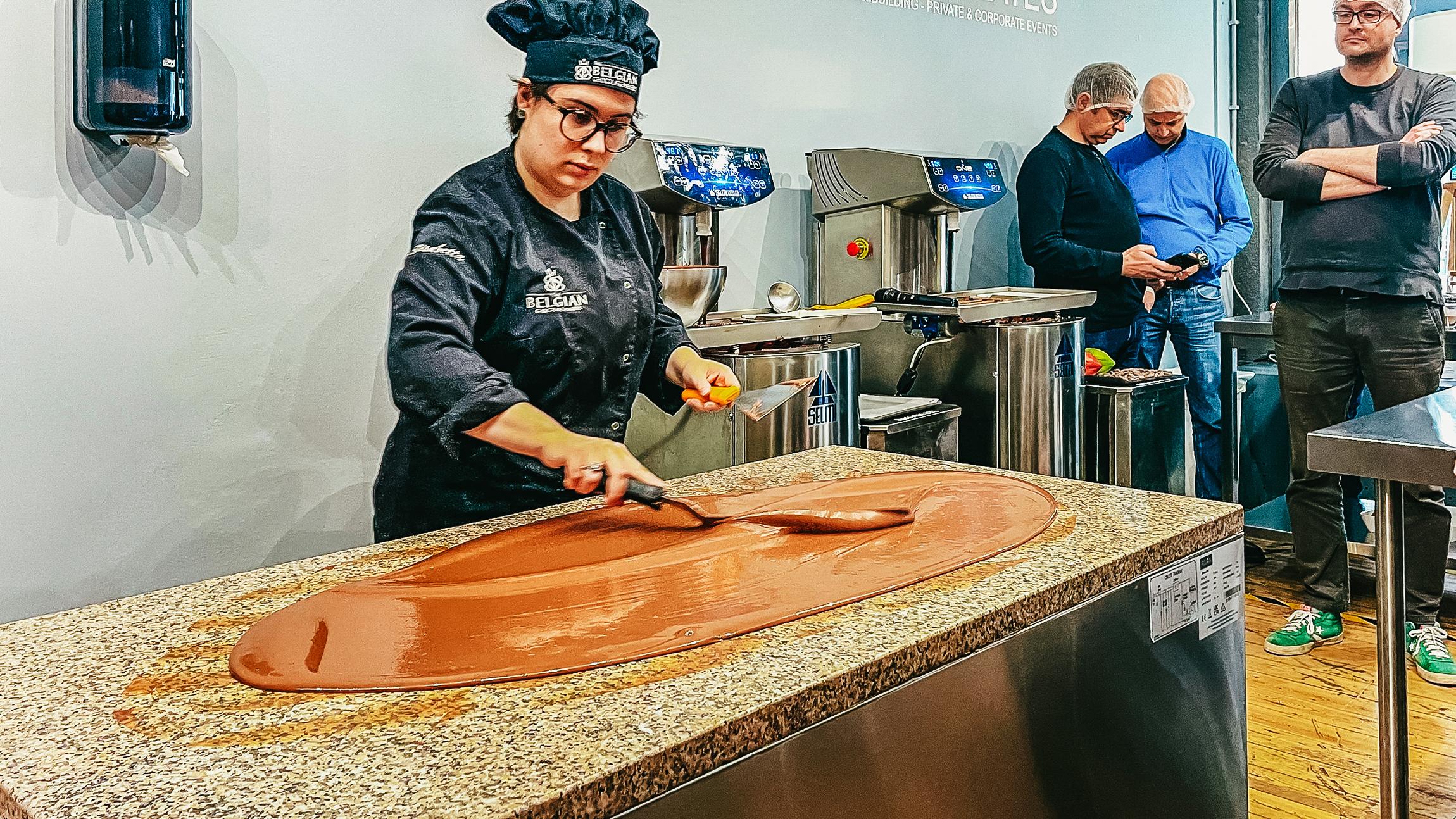
You arrive at Rue de l'Etuve 41 between 10:00 and 12:00, when the mornings are quieter and less crowded than the busy afternoons. The door sits a hundred metres uphill from the Grand-Place, opposite the shuffle of visitors angling their phones at Manneken Pis. You collect the audio guide, choose your language, and descend into the vaulted cellar where the cacao pods are displayed split open, seeds packed in white pulp. You climb back to the demonstration room. A chocolatier ladles tempered couverture onto a marble slab, works it with a spatula and scraper until it thickens, and hands you a warm sample from the blade. You taste it before it sets. Upstairs, the antique moulds hang in rows — hens, fish, bicycles — pressed tin from a century of Easter production. Then the apron. On a brussels chocolate walking tour and workshop you take a station, fill polycarbonate shells with ganache, scrape the surface flat, cap the moulds, and tap out the air bubbles. You wait for the set, then knock the tray and watch the pralines drop free. Some sessions run bean-to-bar instead: you crack roasted beans, winnow the husk, grind the nibs. You leave with a box you assembled yourself. The Grand-Place is two minutes downhill, and the guildhalls catch the afternoon light.

Frequently asked

Frequently asked questions about brussels chocolate walking tour and workshop tours

What are the opening hours for a brussels chocolate walking tour and workshop?

Choco-Story Brussels is open daily from 10:00 to 18:00, with last entry at 17:00.

Is the brussels chocolate walking tour and workshop accessible for wheelchairs?

The museum is accessible to manual wheelchairs; however, electric wheelchairs are not permitted due to the building's layout.

What is included in the brussels chocolate walking tour and workshop tickets?

Tickets include museum entry, a multilingual audio guide, live praline demonstrations, and multiple artisanal chocolate tastings.

Are children allowed on the brussels chocolate walking tour and workshop?

Yes, children are welcome on the tour, but those under 12 must be accompanied by an adult. Strollers are not allowed.

When is the best time to join a brussels chocolate walking tour and workshop?

We recommend arriving between 10:00–12:00 to avoid the larger crowds that typically gather in the afternoons.

Is photography allowed during the brussels chocolate walking tour and workshop?

Photography is allowed in most museum areas for personal use, provided you do not use flash or interfere with demonstrations.

How do I reach the brussels chocolate walking tour and workshop?

The venue is located at Rue de l'Etuve 41, 1000 Brussels, just a short walk from Grand-Place and the Manneken Pis.

What is the cancellation policy for these tours?

You can receive a full refund if you cancel your brussels chocolate walking tour and workshop at least 24 hours before your scheduled time.

Can I combine my brussels chocolate walking tour and workshop with other landmarks?

Yes, the location is walking distance to Grand-Place and Manneken Pis, making it perfect to combine with other Brussels landmarks.